



The search phrase ohio champion trees delaware county usd lewis center combines a real tree-recording subject with a local place name and an unclear abbreviation. Ohio has a champion-tree programme, and Delaware County is a relevant location to check. However, the phrase does not establish a particular champion tree, a school project or a public visitor attraction in Lewis Center.
The most useful approach is to separate those questions: what makes a tree a champion, which record applies to the location, and whether a listed tree can actually be visited. This guide explains that process without inventing a tree location, school affiliation, entry fee or current championship claim.
What is a champion tree?
A champion tree is recognised through a programme that compares large specimens within a species. It is not simply the tallest tree somebody has noticed, nor a title that can be confirmed from an impressive photograph. The relevant programme's measurements, species identification and record status are the important evidence.
The National Champion Tree Program maintains information about state programmes and explains how trees are scored. State recognition and national recognition are different levels of a record. A tree described as a local favourite, a county landmark or a large specimen should not automatically be called a current state or national champion.
| Question | Evidence needed |
|---|---|
| Champion status | Current programme record |
| Lewis Center location | Verified precise location |
| Visitor access | Landowner or park permission |
| School connection | Specific official school source |
Understanding Delaware County and Lewis Center
Delaware County in Ohio must be distinguished from the US state of Delaware. Search results about Delaware's big trees can refer to a different jurisdiction entirely. Check the state, county and administering organisation before treating a result as evidence about a tree near Lewis Center.
Lewis Center is also a more specific location than an entire county. A record associated with Delaware County does not establish that the tree stands within Lewis Center or beside a public road there. County-level information can be useful for narrowing research, but it should not be converted into precise directions without a verified location.
What does USD mean in this search?
The intended meaning of USD in the supplied phrase could not be verified. It may be an abbreviation or an accidental addition, but assigning it a definite interpretation would be speculation. In particular, it should not be expanded into a school-district name merely to make the phrase sound complete.
Olentangy Local School District has an official website and a Lewis Center address. That establishes a real local education organisation, not a connection between the district and a champion-tree record. A school-related claim needs a specific school publication, project page or confirmation rather than an inference from nearby geography.
How champion-tree points work
The National Champion Tree Program describes a score combining trunk circumference in inches, height in feet and one quarter of average crown spread in feet. This mixed-unit formula is the programme's scoring convention. It should not be mistaken for a measurement of volume, carbon storage or the tree's age.
In plain language, three aspects of size contribute: the distance around the trunk, the vertical height and the spread of the canopy. The crown contribution is reduced to a quarter of its average spread. A tree can therefore score strongly through a combination of dimensions rather than winning solely because it is exceptionally tall.
This article deliberately does not insert sample measurements and present them as a real Delaware County tree. If you use a worked calculation for practice, label it as hypothetical. For an actual nomination, retain the observed measurements, the method, the date and the species identification so someone else can evaluate the record.
How to verify a claimed local champion
Begin with the relevant state programme through the national programme's directory. Look for the species name, county, score, measurement date and any indication of whether the entry is current. If the page is unavailable, treat that as an access problem and ask the programme for the record; a broken link does not prove the programme or tree no longer exists.
During research for this guide, some Ohio Department of Natural Resources champion-tree pages appeared in search results but returned unavailable responses when opened. Consequently, this article does not certify a specific current Lewis Center champion. Cached snippets can point towards a record worth checking, but they are not a substitute for confirming the live entry and its status.
Next, check whether the location is public and whether access information is current. A tree might be recorded on private land, institutional grounds or a site with seasonal restrictions. A championship listing does not itself provide permission to enter. Seek the landowner or managing organisation's visitor information before planning a trip.
Measuring a tree responsibly
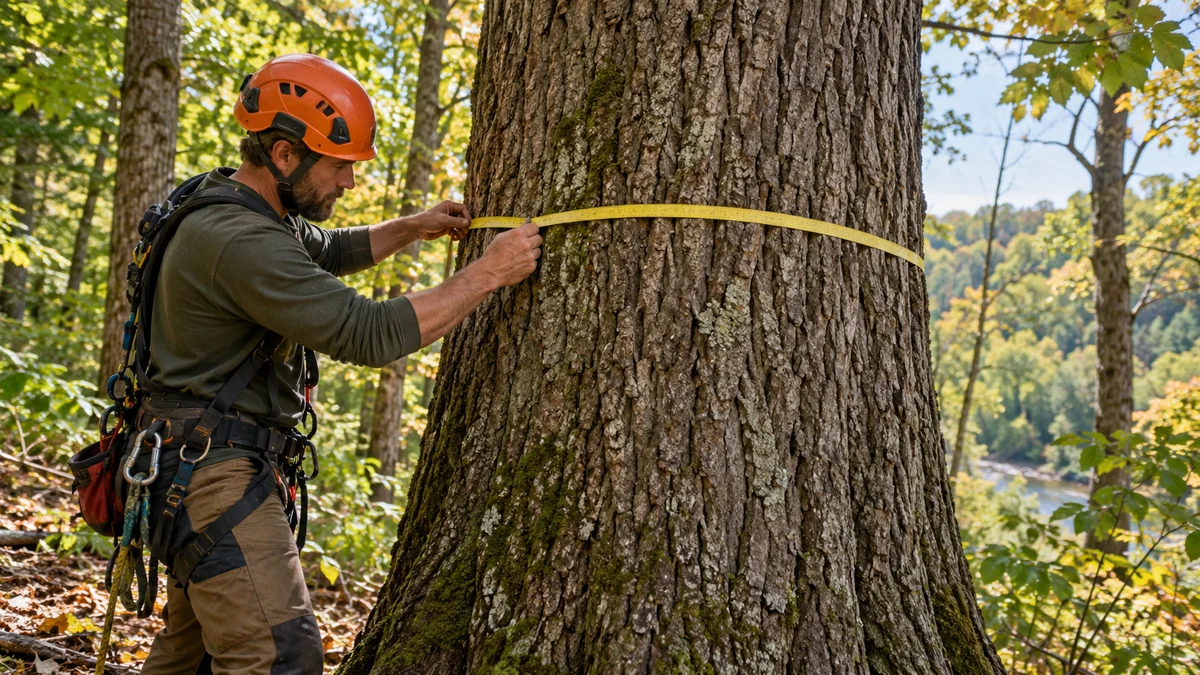
The USDA Forest Service publishes guidance on measuring a big tree. Its usefulness lies in showing that measurement is a methodical process. Trunk shape, sloping ground and branching can complicate a casual reading, so follow the programme's instructions and record any unusual features that may affect the result.
Height and canopy measurements can be especially difficult to estimate accurately from the ground. A dramatic angle in a photograph may exaggerate apparent size. If you think a tree could qualify, ask the programme what information is needed and whether a trained measurer should verify it before any championship claim is made.
Do not damage bark, cut branches or disturb the root area to improve access for a measurement. Obtain permission where required and choose a safe position. If the tree is near a road, power line or other hazard, leave the assessment to an appropriately equipped person rather than improvising a risky survey.
A useful field-study activity
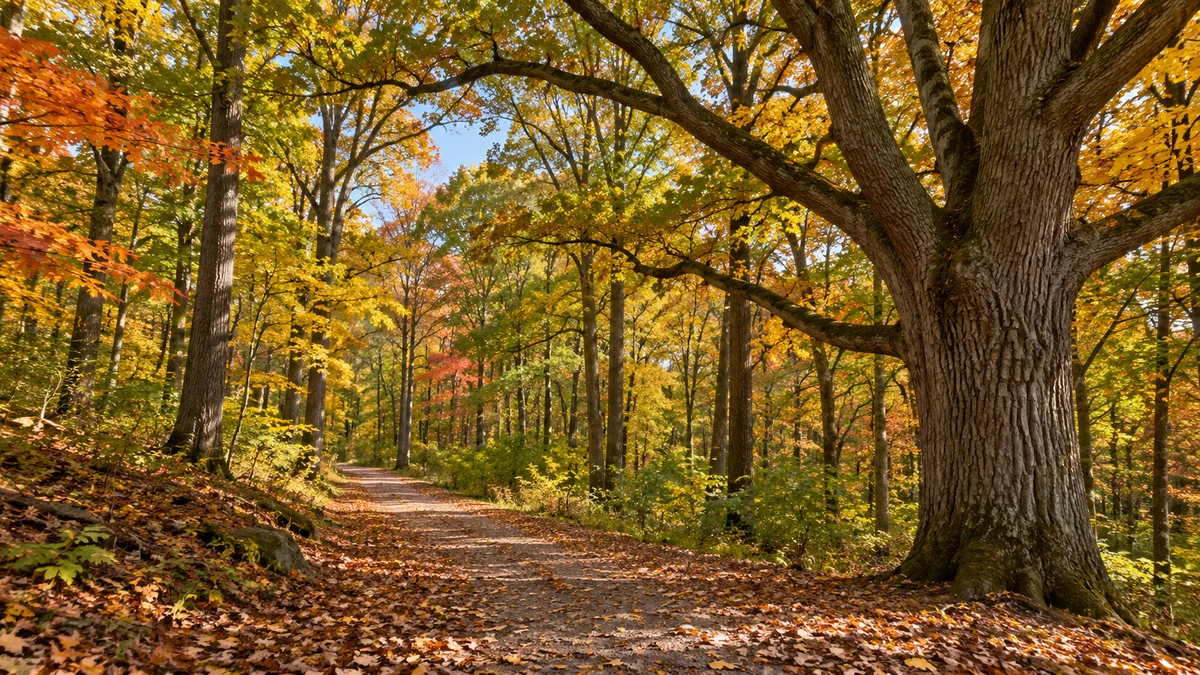
Students and families can learn from ordinary trees without needing to find a record holder. Identify a species with a reliable guide, observe the trunk and canopy, and note the setting. Keep observations separate from conclusions: a broad trunk is something you can record, while a claim about age needs additional evidence.
A simple notebook can include the date, general location, species confidence and questions for later research. Revisit the same tree to compare seasonal appearance. This is an educational suggestion, not a verified Olentangy school assignment. Our Duaction guide explains the broader idea of connecting study, observation and review while avoiding unsupported claims about a branded learning method.
Planning a visit near Lewis Center
Decide whether your goal is seeing a particular verified tree or simply enjoying a woodland walk. For a named tree, confirm the record and location first. For a general visit, use the managing park or landowner's official information for opening arrangements, parking, trail conditions and accessibility instead of relying on a generic champion-tree article.
Avoid treating a map pin in a social post as a guaranteed route. Land use, paths and access arrangements can change. A responsible guide should identify the source of directions and the date checked. Because this article has not verified a specific publicly accessible Lewis Center champion, it does not provide invented turn-by-turn instructions.
Frequently asked questions
Is every large Ohio tree a champion?
No. Size alone is not a confirmed title. A champion claim depends on the relevant programme's criteria and current records for the species. A tree may be impressive and valuable without appearing in a registry.
Does a county listing mean the tree is in Lewis Center?
No. County-level records cover a wider area. Confirm the precise location and public access separately. Also make sure the source concerns Delaware County, Ohio, rather than the state of Delaware.
Can this guide name the current champion at a local school?
Not from the evidence verified here. The school connection and the meaning of USD remain unestablished. The practical next step is to obtain the specific state record and, if a school is named, a matching official school source before making or repeating that claim.
Images are editorial illustrations; they do not document an actual event, installation or named tree.
References and related reading
nationalchampiontree.org — state programs
nationalchampiontree.org — tree measurements
fs.usda.gov — how to measure big tree stelprdb5202838.pdf
olentangy.k12.oh.us — www.olentangy.k12.oh.us
Related DailyInsights reading: General News.
Related DailyInsights reading: Duaction.
