



Visionics was a biometric technology company whose merger with Identix was completed on 25 June 2002. That completion date is documented in Identix's annual report filed with the US Securities and Exchange Commission. Readers encountering the name in an old report should treat it as a historical company reference, rather than assume it identifies a current standalone consumer app.
The useful way to understand Visionics is to separate three questions: what the company record establishes, how biometric recognition works in general, and what evidence would be needed to assess any present-day product using a similar name. Historic corporate material cannot establish today's support arrangements, security performance or software availability.
What was Visionics?
Identix's 2002 filing describes Visionics as a provider of biometric technologies and identification information systems. Biometrics uses measurable characteristics to assist recognition of individuals. Facial recognition and fingerprint recognition are familiar examples, but a company operating in this field should not be assumed to offer every possible biometric capability.
The name belongs in the history of commercial identification technology. Older coverage can be valuable for understanding that history, provided its dates remain attached. An archived announcement describes what was proposed or offered at that time. It is not automatically a present-day sales brochure, download source or statement of current ownership.
| Question | Reliable evidence |
|---|---|
| Merger agreed | February 2002 agreement filing |
| Merger completed | 25 June 2002 annual-report disclosure |
| Historic capabilities | Contemporary product documentation |
| Current software | Present developer and verified distribution |
| Accuracy | Task, version, threshold and test conditions |
This article focuses on the Visionics Corporation named in the Identix transaction. Businesses, products and websites can share similar words. If the reader has a different Visionics in mind, the exact legal name, website, country and product are needed before claims about the historical US company can safely be transferred to it.
The 2002 merger: announcement and completion
A February 2002 SEC filing records the agreement between Identix, its acquisition subsidiary and Visionics. The agreement date was 22 February 2002. The proposed structure involved the acquisition subsidiary merging into Visionics, with Visionics surviving as an Identix subsidiary. This was the proposed transaction, not yet evidence that the merger had closed.
The later annual report supplies the completion evidence: 25 June 2002. It also explains that the fiscal year ended 30 June 2002 included Visionics's results for only the final three business days. That detail matters when someone tries to compare annual revenue before and after a transaction. The first consolidated year did not contain a full year of the acquired business.
The filings state an exchange ratio of 1.3436 Identix shares for each Visionics share. The ratio is a transaction term, not a current share price. It should not be used to infer what an old certificate is worth today, nor does it mean Visionics stock continued trading independently after the combination.
Why old transaction values can differ
Merger coverage can contain several values: an announcement estimate based on a market price, the value of shares issued, and an accounting purchase price that includes other elements. These figures answer different questions. A reporter or researcher should identify both the valuation date and the definition before comparing them.
This is especially relevant to stock-for-stock transactions. A fixed exchange ratio and a changing share price can produce different implied values at different dates. Options, warrants and transaction costs may also affect the accounting figure. An apparent difference between two reports is therefore a reason to inspect their terms, not immediate proof that one has invented its number.
For most readers, the completion date and the change in corporate status are more useful than an isolated headline valuation. This guide avoids turning an archival transaction into a speculative present-day investment story. Anyone investigating historical share entitlements needs the relevant transfer-agent and corporate-action records, rather than a general technology explainer.
What facial recognition actually compares
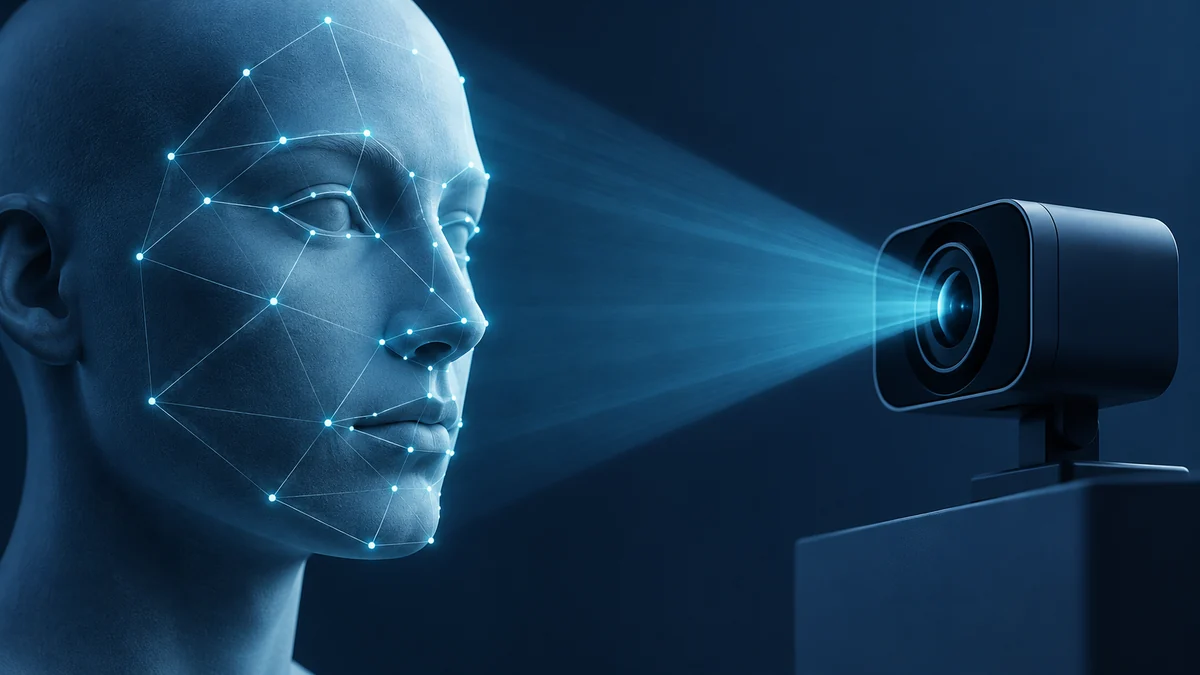
Modern regulator guidance provides a useful conceptual explanation of biometric recognition. A system compares a new sample with a stored reference and assesses their similarity. It applies a threshold to help decide whether the comparison is sufficiently close. The result is a statistically informed decision, not an infallible statement of identity.
There are two different tasks to distinguish. Verification asks whether a person matches a claimed identity, typically a one-to-one comparison. Identification searches for a possible match within a set of identities. These tasks create different evaluation questions. A performance claim for one task should not be casually reused for the other.
This explanation describes biometric recognition generally. It does not assign a particular modern architecture, model, accuracy score or deployment to historic Visionics products. Those claims would require product documentation and test results from the relevant period. A plausible technical description is not enough to establish what a named company actually shipped.
Accuracy, thresholds and errors
The UK Information Commissioner's Office distinguishes false acceptance from false rejection. In a false acceptance, different individuals are incorrectly treated as a match. In a false rejection, samples from the same person are not recognised as matching. Both errors matter, and reporting only one can conceal the trade-offs involved.
Consider a hypothetical access-control system. Setting its threshold more strictly might reduce one kind of mistake while making access harder for legitimate users. The appropriate balance depends on the actual use case and safeguards. This is an explanatory example, not a test result for Visionics or a claim about a specific deployed system.
NIST's evaluation material also shows why photography and population characteristics deserve attention. Image quality can affect false non-matches, and demographic differences require careful measurement. A broad claim that facial recognition is simply accurate or inaccurate leaves out the algorithm, dataset, task and threshold that make a result meaningful.
How to evaluate an old biometric claim
Start by recording the product name, version and date. Then identify whether the claim comes from the vendor, a customer description or an independent evaluation. A vendor announcement is primary evidence of what the vendor said; it is not the same thing as an independent demonstration that the claimed performance was achieved.

Next, ask what the test measured. Was the image set controlled? Was the system verifying a claimed identity or searching a database? Were unsuccessful matches and missed matches both counted? Without these details, a percentage may sound precise while saying little about practical reliability.
Finally, avoid using a current benchmark to certify a historical product. Algorithms and testing methods change. A modern NIST page helps explain how performance is assessed today, but it does not retroactively validate an old system or establish that an archived company name appears among current participants.
Is there a current Visionics app or download?
The historical merger record does not establish a current official consumer download. Before installing anything carrying the name, identify the present developer and obtain the software through that developer's verified distribution channel. A familiar historic name is insufficient evidence that a file belongs to the old business or its successors.
The same applies to support and pricing. A page quoting an old product does not prove that licences are currently sold, that updates remain available or that the seller is authorised. For a legacy installation, the practical starting point is the original contract, version record and current accountable support provider.
Why Visionics remains a useful research topic
Visionics illustrates how technology history and company history overlap. A merger changes the way financial results and products are described, while a familiar brand may remain searchable long afterwards. Understanding that overlap helps readers avoid treating archival material as a live product review.
The documentary record supplies a firm historical anchor. The broader lesson is to pair a technical claim with its actual test and a corporate claim with its dated filing. That produces a more useful account than attaching today's AI vocabulary to an old name without evidence.
Frequently asked questions
When did Visionics merge with Identix?
The merger was completed on 25 June 2002, according to Identix's SEC-filed annual report. The agreement had been signed in February.
Does a biometric match prove identity with certainty?
No. Biometric comparisons are probabilistic and can produce false acceptance or false rejection. Their use needs appropriate evaluation and safeguards.
Does this history verify a modern app using the name?
No. A current app requires separate evidence about its developer, distribution, capabilities and support. Historical corporate filings do not provide that verification.
Images are AI-generated editorial illustrations, not documentary photographs.
References and related reading
ico.org.uk — biometric recognition
Related DailyInsights reading: Tech.
Related DailyInsights reading: Business.
