



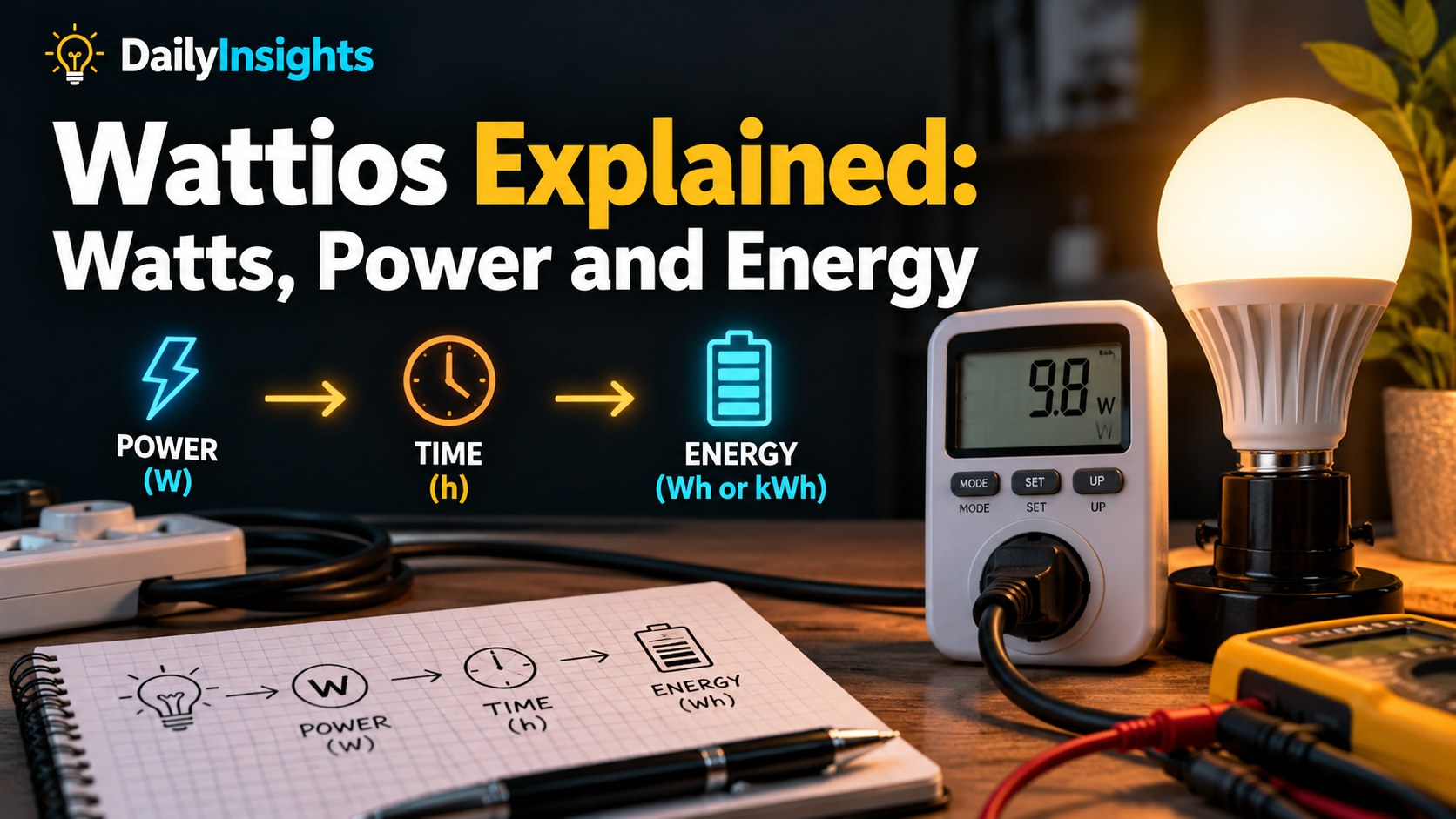
Wattios is not the standard English spelling of the electrical unit. Readers often mean watts, or the Spanish plural vatios. A watt, symbol W, is the International System of Units measure of power and is equivalent to one joule per second.
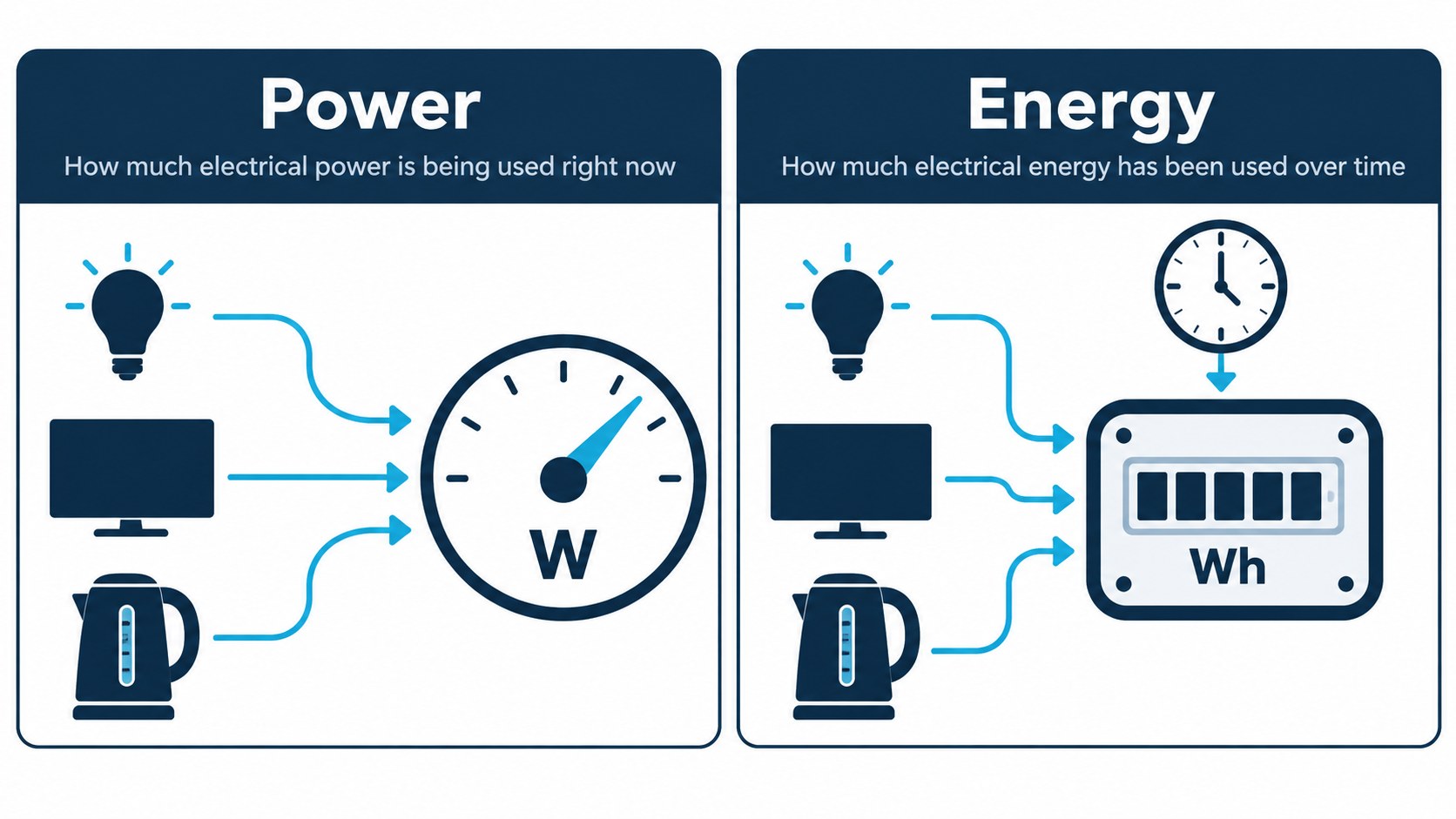
The most important practical distinction is between watts and watt-hours. Watts describe the rate at which energy is transferred or used at a moment; watt-hours describe an amount of energy over time. Confusing the two can make appliance, battery and electricity-cost comparisons inaccurate.
Image note: The featured and supporting images are AI-generated editorial illustrations, not documentary photographs or actual incident images.
Wattios, watts and vatios
In English, the unit name is watt and the plural is watts. Spanish uses vatio and vatios. “Wattios” appears to blend the English spelling with the Spanish plural pattern, but it should not be presented as the formal SI name.
The Bureau International des Poids et Mesures identifies watt, symbol W, as the derived SI unit for power. The Real Academia Española lists vatio as the Spanish unit name. These references provide the correct forms for formal technical writing.
If a product page uses Wattios, check the page language and manufacturer documentation. It may be informal localisation rather than a separate specification.
What a watt measures
Power is the rate of energy transfer. One watt means one joule of energy per second. A device rated at a higher wattage can transfer or consume energy at a higher rate under the stated conditions, but the label alone does not tell you how long it operates.
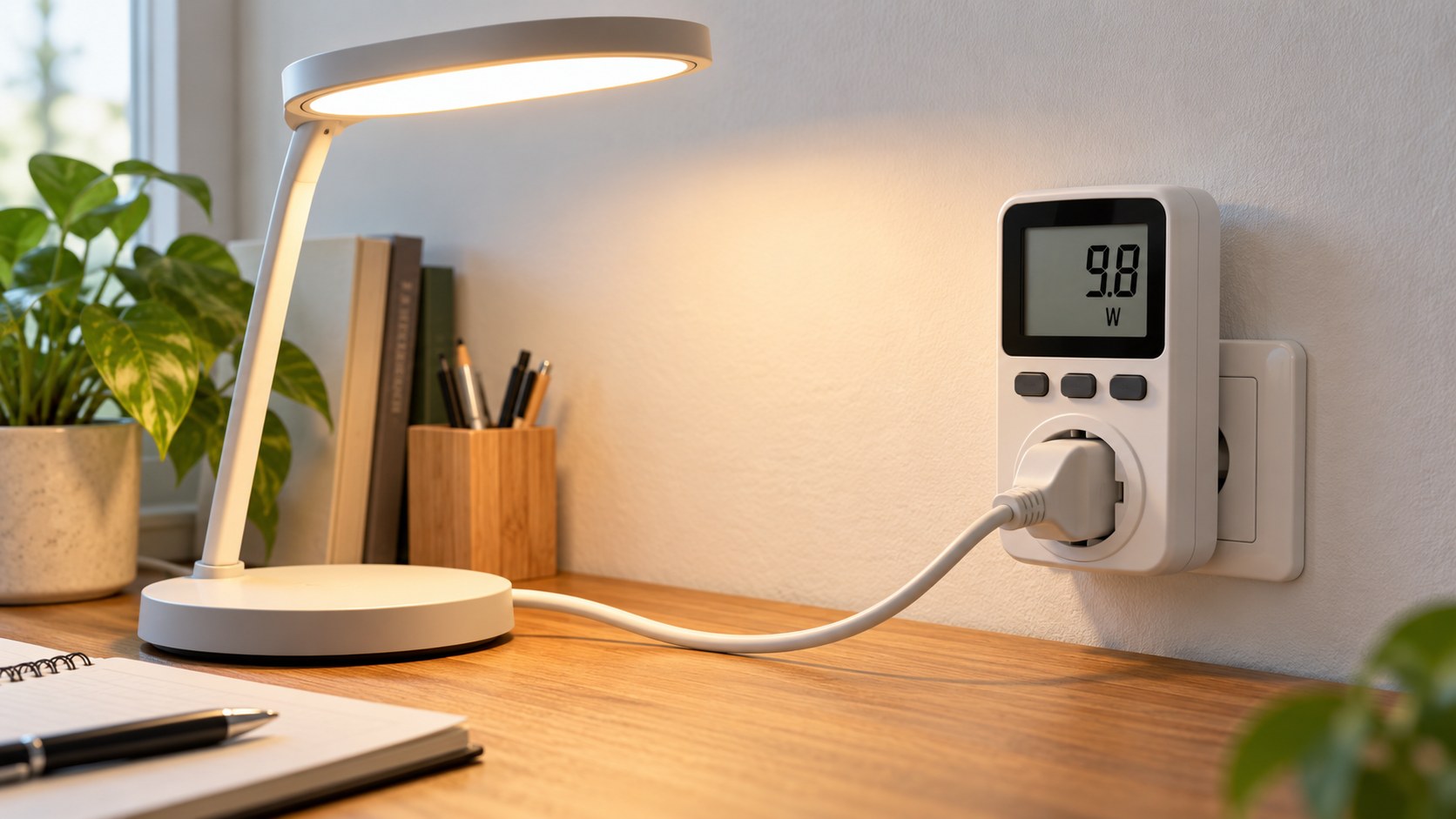
For example, a lamp marked 10 W has a power rating. If it runs for five hours, energy use is calculated by multiplying power by time. The result is 50 watt-hours, or 0.05 kilowatt-hours.
Real devices may vary with settings, load and operating mode. A nameplate can give maximum, nominal or typical power depending on the product and standard. Read the label and manual before treating one number as continuous consumption.
Watts versus watt-hours
Watts answer “how fast?” Watt-hours answer “how much over a period?” A 100 W device operating for one hour uses 100 Wh in the simplified calculation. The same device operating for ten hours uses 1,000 Wh, equal to 1 kWh.
Electricity bills commonly use kilowatt-hours because household consumption over a billing period is much larger than a single watt-hour. A tariff priced per kWh applies to energy, not to the appliance’s watt rating by itself.
The distinction also matters for batteries. Battery capacity may be given in watt-hours, while a charger or motor has a watt rating. Dividing nominal capacity by power can give a rough duration, but losses, limits and changing load mean real runtime differs.
Reading appliance labels
Look for the quantity and unit together. W indicates power; V indicates voltage; A indicates current; Hz indicates frequency; Wh or kWh indicates energy. Similar letters are not interchangeable.
Some labels state input power and output power separately. A power supply may draw more from the socket than it delivers to a device because conversion is not perfectly efficient. Compare like with like.
If the label gives only voltage and current, multiplying them can provide an apparent-power or rough upper-bound figure in some simple cases, but alternating-current equipment may require power factor and other information. Use the manufacturer’s stated wattage or a suitable meter for a reliable comparison.
Measuring power safely
A plug-in power meter can measure many ordinary plug-connected appliances. Follow the meter’s current, voltage and power limits, and do not use damaged equipment. High-power fixed installations should be assessed by a qualified person.
Allow the device to run through representative modes. A refrigerator cycles, a computer changes with workload, and a heater may use a thermostat. A brief reading can miss those patterns.
For energy use, measure over a meaningful period or use the meter’s accumulated kWh function. Record the duration and settings so that another person can understand the result.
Estimating electricity cost
Convert watts to kilowatts by dividing by 1,000, multiply by operating hours, then multiply the resulting kWh by the applicable tariff. Use the complete tariff information, because standing charges, time-of-use rates and taxes can affect the bill.
An estimate should state its assumptions. “Used eight hours every day” is different from “left plugged in but mostly idle”. Measuring actual use is usually better than relying on a maximum label.
Do not invent savings percentages. An efficient replacement should be compared at equivalent brightness, output or work performed, and over a realistic usage pattern.
Common misunderstandings
More watts do not always mean a better product. In lighting, efficiency and light output matter; in computing, performance per watt can matter; in heating, the required output and control system matter.
Watts also do not measure voltage. Voltage, current, resistance, power and energy describe different electrical quantities. A safe product comparison should keep their units visible.
A watt is not the same as a watt-hour, and neither is automatically a billing price. Units are a compact language; preserving the symbol and context prevents most errors.
Choosing equipment from wattage information
Begin with the job the equipment must perform, then compare power alongside output, efficiency, duty cycle and controls. Two products with the same watt rating may deliver different useful results. Conversely, a lower-wattage product may take longer to complete the same task, so its total energy use is not automatically lower.
For electronics, check whether the stated figure describes the device, its supplied adaptor or a recommended power supply. A computer power supply rated for a particular maximum does not continuously draw that amount. For solar panels, output depends on conditions; for audio equipment, different rating methods may not be comparable. Always use the relevant standard and the manufacturer’s complete specification rather than a single headline number.
Frequently asked questions
Is Wattios the correct English spelling?
No. Use watts in English. Vatios is the standard Spanish plural.
What does W mean?
W is the SI symbol for watt, the unit of power.
Is 1 watt equal to 1 joule?
One watt is one joule per second, a rate of energy transfer. A joule itself is an amount of energy.
Why does my bill use kWh?
Billing measures energy accumulated over time, so kilowatt-hours are more useful than instantaneous watts.
Wattios is therefore best interpreted as a spelling or localisation issue, not a new electrical unit. Use watt or watts in English, vatio or vatios in Spanish, and keep power separate from energy when comparing devices.
Authoritative reference: bipm.org.
Authoritative reference: bipm.org.
Authoritative reference: dle.rae.es.
Continue with this relevant DailyInsights resource: Quantumrun.
Continue with this relevant DailyInsights resource: Tech.

1 Comment
Pingback: FiberNl: Fiber Nederland Internet Guide